Shimano Nasci vs. Daiwa Exceler
Shimano Nasci FC vs. Daiwa Exceler LT: Which Mid-Range Spinning Reel Is Better? (Full Field Test)
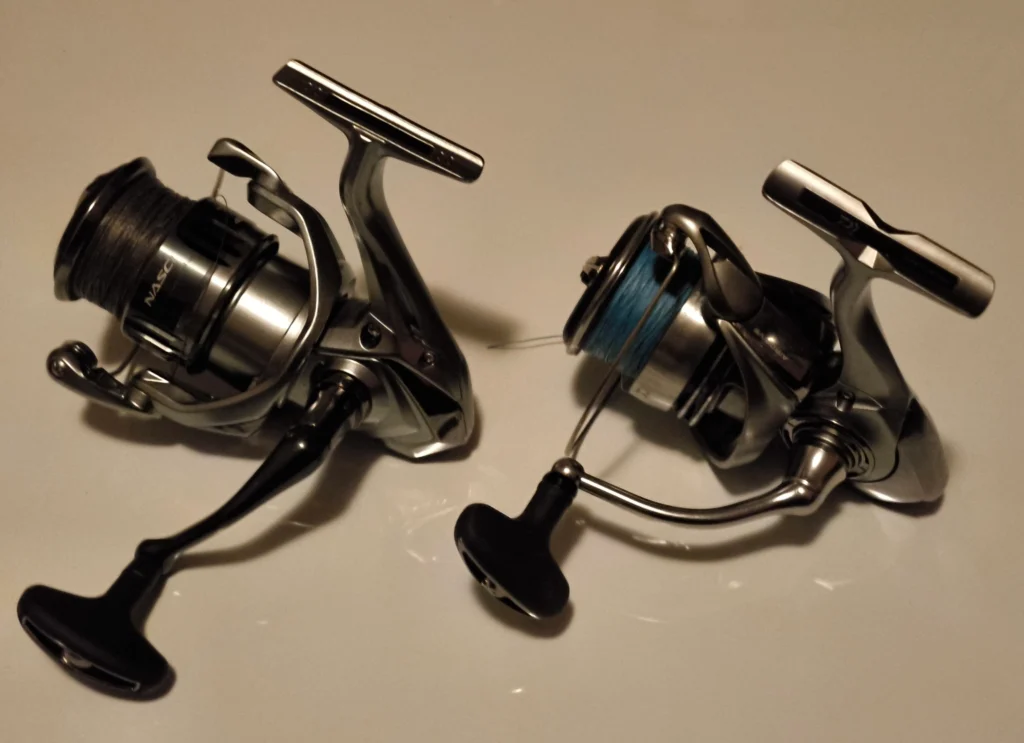
Shimano and Daiwa are the titans of the fishing world, and for a good reason: they offer high-performance gear even if you’re on a budget. In this head-to-head comparison, I’m breaking down two of the best spinning reels in the $100 price bracket.
I’ve put the Shimano Nasci FC 4000XG and the Daiwa 23 Exceler LT4000D-C through a rigorous 1-year field test to see which one holds up when the pressure is on.
While the Daiwa Exceler usually sits right at the $99 mark, the Shimano Nasci often hovers around $109, making them the go-to choices for anglers looking for professional features without the professional price tag.
Beyond the specs, I’ll share the real-world performance quirks I discovered on the water. If you’re still weighing your options for other categories, don’t forget to check out my Ultimate Spinning Reel Buyer’s Guide for a deep dive into what really matters when picking your next workhorse.
Technical Specifications
To give you a better idea of how they stack up, here are the key specs for the 4000-sized models I tested:
| Feature | Shimano Nasci FC 4000XG | Daiwa 23 Exceler LT4000D-C |
|---|---|---|
| Weight | 10.1 oz | 8.1 oz |
| Body Material | XT-7 Composite (Solid Feel) | Zaion V (Carbon-Based Composite) |
| Saltwater Ready | No (Rinse after use) | No (Freshwater only) |
| Gear Ratio | 6.2:1 | 5.2:1 |
| Max Drag | 24 lbs | 26.4 lbs |
| Line Capacity (Mono) | 10 lb / 200 yds | 12 lb / 160 yds |
| Bearings | 5+1 | 5 |
| Main Tech | Hagane Gear, CoreProtect | Zaion V Body, Air Drive Design |
Even though both reels are 4000-sized models, they cater to very different styles of fishing. The differences in gear ratio, line capacity, and body construction are significant once you hit the water.
The Shimano Nasci FC is built for speed and power. With its high-speed 6.2:1 gear ratio and a slightly heavier build, it’s the ultimate choice for techniques that require a fast retrieve.
If you’re burning lures for fast-moving predators or need to pick up slack line quickly after a long cast, the Nasci’s high inches-per-turn (IPT) is a game changer.
Its body, made from the proven XT-7 composite, provides the rigidity and “solid feel” needed to stay in control during heavy fights or when throwing oversized lures.
In stark contrast, the Daiwa Exceler LT is a featherweight champion. At just 8.1 oz, it is a full 2.0 oz lighter than the Shimano. That is a massive difference you will definitely feel in your wrist after a full day of active lure fishing.
While the Nasci focuses on speed and ruggedness, the Exceler scores with a higher max drag of 26.4 lbs and the innovative Zaion V material, which offers maximum stability with minimal weight.
The Verdict: Which one should you pick?
- Choose the Shimano Nasci FC if you need a robust “workhorse” with high-speed recovery for power fishing and heavy-duty use.
- Choose the Daiwa Exceler LT if you want an incredibly light, fatigue-free setup for finesse techniques where every ounce counts.



Shimano Nasci vs. Daiwa Exceler: Real-World Performance & Field Test Insights
Specs and numbers are one thing, but features like line management, retrieval smoothness, and drag consistency can only be truly judged once you’re out on the water. You don’t really know a reel until you’ve spooled it up and hooked a hard-fighting fish.
In this section, I’m diving into my hands-on experience with both reels. I’ll highlight the subtle details – the things you won’t find in a marketing brochure – that I discovered during a year of use in various conditions.
Line Management
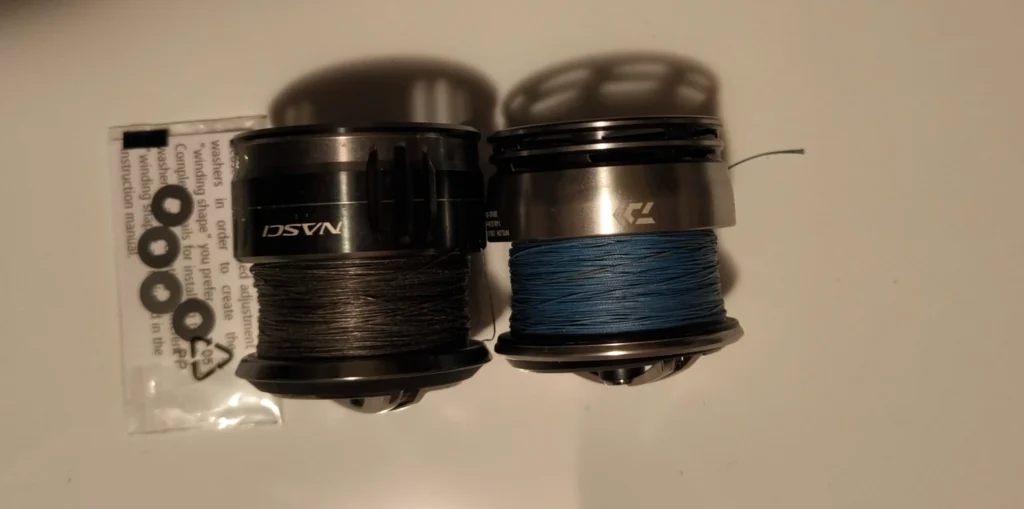
Before heading to the water, I spooled both reels with braided line. Overall, the line management on both models is solid for this price point. You might notice some minor irregularities, but that is perfectly normal for reels in the sub-$110 category.
The Shimano Nasci FC 4000XG showed a slightly “concave” line lay, meaning the line piles up a bit more at the top and bottom edges of the spool, leaving the middle slightly lower. What I really appreciate is that Shimano includes four spool washers (shims) in the box.
If the line lay bothers you, you can simply remove the drag knob and spool, add a washer to the shaft, and reassemble. This raises the spool slightly to level out the line. I haven’t felt the need to use them yet, as it hasn’t affected my casting, but it’s a great “pro-level” touch to have that option included.
The Daiwa 23 Exceler LT4000D-C also showed a slight bias, with the line stacking a bit higher toward the front (top) of the spool.
While it’s minor, it is worth noting that Daiwa does not include extra shims in the box for this specific model. If you want to fine-tune the line lay on the Exceler, you’ll have to source your own washers or live with the factory setting.
Smoothness and Retrieval Feel
During my countless hours on the water, I found that both reels operate incredibly quietly with almost no detectable gear noise. There is often some confusion regarding bearing counts: the Shimano Nasci FC is listed as 5+1, while the Daiwa Exceler LT is listed as 5.
It’s important to understand that these manufacturers simply use different labeling standards.
Shimano’s “5+1” stands for five ball bearings and one roller bearing, whereas Daiwa also utilizes a roller bearing for their instant anti-reverse but doesn’t list it as “+1.” Technically speaking, both reels are completely on par when it comes to the internal bearing setup.
In terms of noise, both reels are so quiet that you really have to listen closely to notice any difference. However, I found the Nasci FC to be slightly stealthier than the Exceler LT. This is likely due to Shimano’s Silent Drive technology, which reduces minute gaps and vibrations within the gear train.
The most significant difference, however, is the startup inertia. I performed a simple test by positioning the handle of both reels parallel to the ground and letting go.
The Shimano Nasci handle stayed in place, while the Daiwa Exceler handle immediately rotated 90 degrees downward. The Daiwa practically starts moving on its own. This effortless rotation is a massive advantage for finesse anglers who want the most direct and sensitive lure feel possible.
Durability & Protection
During my long-term testing, I put the Shimano Nasci FC 4000XG through its paces while lure fishing with heavy baits and for bottom fishing. The Daiwa 23 Exceler LT4000D-C, on the other hand, was used exclusively for bottom fishing setups.
After a full year, I honestly haven’t noticed any difference in longevity – both reels still perform as smoothly as they did on day one. It is worth noting, however, that I primarily used them in fair weather and didn’t expose them to extreme storms or torrential rain.
When it comes to out-of-the-box protection and long-term durability, the Shimano Nasci FC has a slight edge due to the combination of CoreProtect and Hagane Gear.
CoreProtect is a water-repellent coating on the line roller and the body that prevents water and grime from entering the inner workings. Coupled with the cold-forged Hagane gears, it’s built to ensure a reliable retrieve for years to come.
It is important to mention that while Daiwa has its own legendary sealing technology called MagSealed (a magnetic oil system that creates a waterproof barrier), the Daiwa 23 Exceler does not feature MagSealed protection.
This is a key detail to keep in mind if you often fish in conditions where your gear is constantly exposed to the elements.
Drag Performance
A reel is only as good as its drag when a trophy fish decides to run. During my tests, I focused on two key requirements: startup smoothness to prevent line snaps and precise adjustability for different fishing techniques.
When lure fishing, I aim for a balanced drag setting. I want enough resistance to drive the hook home and ensure a solid hookset, but enough smoothness so the line won’t snap during a violent strike.
On both the Nasci and the Exceler, I found my “sweet spot” for lure fishing by backing off exactly three full turns from the locked position.
This specific setting provides the perfect amount of tension – strong enough to set the hook, yet responsive enough to provide immediate give during the first powerful run of a predator.
If you need to go even lighter – for example, for bottom fishing where a fish like a Channel Catfish or a heavy Bass needs to take line without resistance – both reels offer plenty of additional adjustment range. Even at these ultra-light settings, the drag remains completely jerk-free.
This is crucial to prevent the fish from feeling suspicious resistance and to ensure your rod stays safely in its holder. Whether you are power fishing or finesse angling, both the Shimano Nasci FC and the Daiwa 23 Exceler LT deliver a reliable, professional-grade drag performance.
Final Verdict: Which Reel Wins?
After my extensive field test, the result of this duel can be summarized quite simply: There is no clear loser here, but rather two very different specialists. Both reels offer incredible value for the money, but they cater to different philosophies on the water.
The Shimano Nasci FC 4000XG is my top pick for anyone seeking a robust workhorse. Thanks to the Hagane Gear and CoreProtect, it feels built for the long haul, and the Silent Drive technology makes it run just a bit quieter.
Including spool washers for fine-tuning the line lay is a level of service and attention to detail that I really appreciate at this price point.
The Daiwa 23 Exceler LT4000D-C is the clear winner when it comes to handling and agility. It has a noticeably lower startup inertia and feels incredibly light on your wrist.
If you don’t typically fish in extreme weather and want a reel that feels “fast” and responsive, the Exceler offers massive performance for the money.
One important detail to note: The new Exceler features a one-piece screw-in handle. While this design provides more stability and eliminates “play” during a fight, it means the handle doesn’t have a folding joint.
For transport in a rod sleeve or case, you can’t just fold it down – you’ll have to unscrew it completely. It’s a small trade-off for a much more solid feel, but something to keep in mind for your storage routine.
My Final Tip: Choose the Shimano Nasci if you want a fast, rugged reel built for long-distance casting and heavy-duty use. Reach for the Daiwa Exceler if lightweight comfort and effortless handling are your top priorities.
One standout advantage of the Exceler’s D-C model: thanks to the Deep Spool design, it offers significantly more line capacity than standard compact models. This is a huge plus if you need those extra yards of line as a “safety reserve” when a powerful fish decides to make a long, unstoppable run.
Frequently Asked Questions (FAQ)
Is the Shimano Nasci FC better for saltwater than the Daiwa Exceler?
While neither reel is fully “saltwater-rated” like a Shimano Saragosa or a Daiwa BG, the Shimano Nasci FC has a slight advantage due to its CoreProtect coating. It can handle light brackish water or salt spray much better than the Exceler, provided you rinse it thoroughly with fresh water after every outing.
Can I use the Daiwa Exceler 4000 for heavy catfish or pike?
Yes, absolutely. Even though the Exceler is very light, its 26.4 lbs of max drag provides more than enough stopping power for large Channel Catfish or Northern Pike. Just keep in mind that its lightweight Zaion V construction is optimized for agility rather than “winching” heavy weights.
Why does the Shimano Nasci feel “heavier” when turning the handle?
This is a combination of two factors. First, the Nasci has a higher gear ratio (6.2:1) compared to the Exceler (5.2:1), which naturally requires slightly more torque to start. Second, the Daiwa Exceler features the innovative Air Drive Rotor.
This rotor is significantly lighter, reducing the rotational inertia to a minimum. While the Nasci feels more “planted” and powerful for fast-moving lures, the Exceler offers that signature effortless, “airy” rotation that Daiwa is known for.
Does the Daiwa Exceler LT4000D-C come with a spare spool?
Typically, no. In the US market, most reels in the sub-$110 price range do not include a spare spool. If you need to switch between braid and monofilament frequently, you may want to consider purchasing an additional spool separately.
Is the “screw-in handle” on the Daiwa Exceler better than a standard handle?
Most experienced anglers prefer a screw-in handle because it threads directly into the main gear. This eliminates the “play” or wobbling often found in cheaper hex-bar handles, resulting in a much more solid and premium feel during the fight.